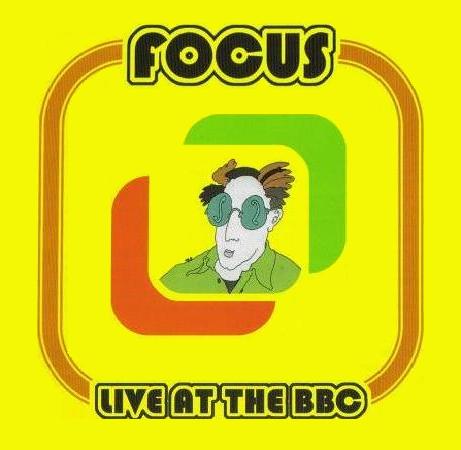
"FOCUS LIVE AT THE BBC" (21
March 1976)
Review by
Simon Lawford
Hux Records, Hux 051
Contents:
01
· Virtuous Woman (Van Leer) 10.58
02
· Blues in D (Ruiter) 3'46
03
· Maximum (Van Leer) 14'01
04
· Sneezing Bull (Catherine) 7'46
05
· Sonata for Flute (Bach/Van Leer) 2'48
06
· House of the King (Akkerman/Flynn) 3'15
07
· Angel Wings (Catherine) 5'39
08
· Little Sister/What you see (Van Leer) 8'18
09
· Hocus Pocus (Akkerman/Van Leer) 5'49 |
 |
Some of us have been waiting a little while for
this release! In fact nearly 30 years have passed since 1976 when Focus made
their last tour to the UK D famously since Jan Akkerman had just departed and
his place been taken by Philip Catherine, a substitution that in the minds of
many Focus fans was tantamount to the demise of the group.
I heard the band play at Southport New Theatre on March 27 on this tour. I was
completely obsessed with Focus at that time, and in particular had a huge
admiration for the unique harmonic style of Thijs van Leer. I have never
forgotten the wonderful, haunting, effect of the opening chords of the first
number, Virtuous Woman, which struck me as one of the best things they had ever
done. Later I acquired the LP Focus con Proby, and that was great because it
contained another outstanding piece played at this concert, Maximum.
So when I heard that this new CD, Focus Live at the BBC was coming out I was
fascinated to find out whether my impressions and memories of the music I had
heard 28 years earlier were accurate.
In short, this CD confirms that Focus imploded at the very time they were
discovering a new and valid direction. Much of the playing is beautifully
spacious and laid back D Maximum for instance is stretched out to 14' compared
to 8'36 on Focus con Proby, and the same feel is evident in the slower opening
sections of Virtuous Woman. Another feature of the band's performance is their
effective use of dynamics, the opening of Virtuous Woman or the final notes of
Little Sister being good examples. The lengthy improvised sections of Eruption
and Anonymous II have given way to more tightly constructed works with Focus'
trademark colourful harmony and imaginative soundscape. Of Catherine's two
compositions Sneezing Bull is probably the more successful, with characterful
musical ideas and textures, and tight rhythm. By comparison Angel Wings is more
relentless with strong, hard driven guitar lines that here, at least, show no
sign of the 'less frenetic style' referred to in David Randall's fascinating
sleeve notes.
Reviews at the time were mixed but included the opinion that van Leer's
compositions were 'rambling' and of little worth, and the only thing that saved
this tour was the injection of new musical ideas from Philip Catherine. Well I'm
sorry, (and I'm a huge fan of Philip Catherine) - but this is complete rubbish.
Close your eyes and listen to the sheer beauty of van Leer's Virtuous Woman,
Maximum and Little Sister. Anyone who has listened to these pieces subsequently
with an open mind and a grain of musical intelligence will tell you that there
is a warmth, a luminosity, an inspiration in these works that makes one reflect,
with great remorse: how did it all go wrong at a time when they were producing
such brilliant stuff? Arguably this set works better on CD than it did as a live
show at the time, especially in view of some fans' disappointment at Akkerman's
absence, and the fairly small amount of old material performed; so to anyone who
is unsure or sceptical about the band's output from this period, can I recommend
that you get a copy of this CD as soon as possible.
So how much difference did Akkerman's departure really make? In spite of what
many Akkerman fans were saying at the time, the band's style had made its most
fundamental change with the release of Mother Focus in 1975 which had already
heralded a softer, jazzier sound and a move away from quasi-symphonic canvasses.
Catherine's style may have been different from Akkerman. Yet this was after all
a mostly new set, and who knows how Akkerman would have played it? If Focus had
changed as much as some were claiming, it was at any rate not just a change of
personnel that had brought this about. Catherine's sound is warm and glowing and
effortless - and it is hard to imagine it any other way.
Simon Lawford
simon@perthcathedral.org